We’re pleased to present to you this year’s Annual Water Quality Report. This report is designed to inform you about the quality water and services we deliver to you every day. Our constant goal is to provide you with a safe and dependable supply of drinking water. We want you to understand the efforts we make to continually improve the water treatment process and protect our water resources. We are committed to ensuring the quality of your water. Our water source is ground water from eleven Regional Utilities wells. All wells draw from the Floridan Aquifer. Because of the excellent quality of our water, the only treatment required is chlorine for disinfection purposes.
In 2025 the Department of Environmental Protection performed a Source Water Assessment on the Regional Utilities system. The assessment was conducted to provide information about any potential sources of contamination in the vicinity of the drinking water wells. There were no potential sources of contamination found near any of Regional Utilities well sites. The assessment results are available on the FDEP Source Water Assessment and Protection Program website here.
If you have any questions about this report or concerning your water utility, please contact Melissa Pilcher, General Manager, or Jason Reddick, Superintendent of Water Operations, at (850) 231-5114. We encourage our valued customers to be informed about their water utility. If you want to learn more, please contact our office at the above number between the hours of 8:00AM-4:30PM Monday through Friday or attend a board meeting on the third Thursday of every month at 5:00PM.
Regional Utilities Water System routinely monitors for contaminants in your drinking water according to Federal and State laws, rules, and regulations. Except where indicated otherwise, this report is based on the results of our monitoring for the period of January 1 to December 31, 2025. Data obtained before January 1, 2025, and presented in this report are from the most recent testing done in accordance with the laws, rules, and regulations.
In the table below, you may find unfamiliar terms and abbreviations. To help you better understand these terms we’ve provided the following definitions:
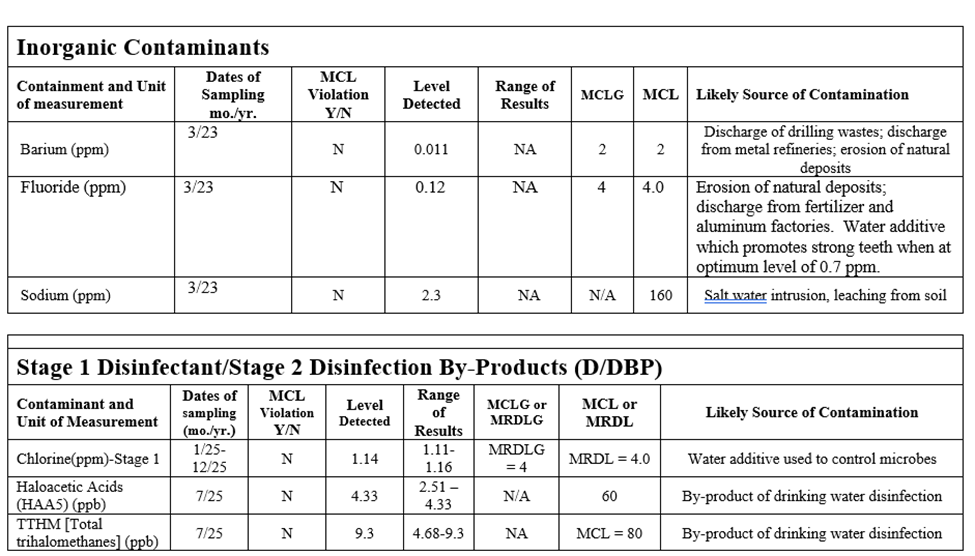
The sources of drinking water (both tap water and bottled water) include rivers, lakes, streams, ponds, reservoirs, springs, and wells. As water travels over the surface of the land or through the ground, it dissolves naturally occurring minerals and, in some cases, radioactive material, and can pick up substances resulting from the presence of animals or from human activity.
Contaminants that may be present in source water include:
In order to ensure that tap water is safe to drink , the EPA prescribes regulations, which limit the amount of certain contaminants in water provided by public water systems. The Food and Drug Administration (FDA) regulations establish limits for contaminants in bottled water, which must provide the same protection for public health.
Drinking water, including bottled water, may reasonably be expected to contain at least small amounts of some contaminants. The presence of contaminants does not necessarily indicate that the water poses a health risk. More information about contaminants and potential health effects can be obtained by calling the Environmental Protection Agency’s Safe Drinking Water Hotline at 1-800-426-4791.
Thank you for allowing us to continue providing your family with clean, quality water this year. In order to maintain a safe and dependable water supply, we sometimes need to make improvements that will benefit all of our customers. These improvements are sometimes reflected as rate structure adjustments. Thank you for understanding.
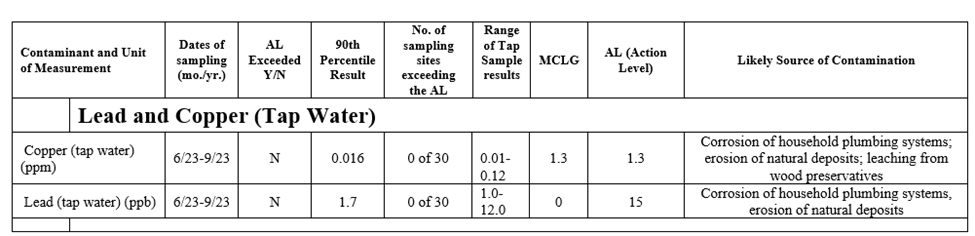
In 2024, the Regional Utilities conducted a thorough inventory of all service connections to detect any Lead service lines in the system. We can state with high confidence that there are no Lead service lines in the Regional Utilities system. The details of this inventory are available here.
None of Regional Utilities’ Lead tap sample survey results have exceeded the action level for Lead in tap water. Routine Lead tap sampling is conducted on a three-year cycle, next due in 2026. Please find the results of the 2023 survey in this report. The complete data from the 2023 survey is available here. Click on Public Oculus Login to access the document.
Lead can cause serious health problems, especially for pregnant women and young children. Lead in drinking water is primarily from materials and components associated with service lines and home plumbing. Regional Utilities is responsible for providing high quality drinking water and removing lead pipes, but cannot control the variety of materials used in plumbing components in your home. You share the responsibility for protecting yourself and your family from the lead in your home plumbing. You can take responsibility by identifying and removing lead materials within your home plumbing and taking steps to reduce your family’s risk. Before drinking tap water, flush your pipes for several minutes by running your tap, taking a shower, doing laundry or a load of dishes. You can also use a filter certified by an American National Standards Institute accredited certifier to reduce lead in drinking water. If you are concerned about lead in your water and wish to have your water tested, contact Regional Utilities at (850)- 231-5114. Information on lead in drinking water, testing methods, and steps you can take to
minimize exposure is available at http://www.epa.gov/safewater/lead.
Some people may be more vulnerable to contaminants in drinking water than the general population. Immuno-compromised persons such as persons with cancer undergoing chemotherapy, persons who have undergone organ transplants, people with HIV/AIDS or other immune system disorders, some elderly, and infants can be particularly at risk from infections. These people should seek advice about drinking water from their health care providers. EPA/CDC guidelines on appropriate means to lessen the risk of infection by Cryptosporidium and other microbiological contaminants are available from the Safe
Drinking Water Hotline (800-426-4791).
Regional Utilities Water System would like you to understand the efforts we make to continually improve the water treatment process and protect our water resources. We are committed to insuring the quality of your water. If you have any questions or concerns about the information provided, please feel free to call any of the numbers listed.